2026 - LILIANE TOMASKO
Programmation en "Résonance" de la 18e Biennale de Lyon - Art contemporain
Part of the "Résonance" program of the 18th Lyon Biennal of Contemporary Art 2026
Du 16 septembre au 18 novembre 2026
Commissaire de l'exposition / Curator : Marjolaine LÉVY
2 créneaux horaires par jour, en visite libre :
10h-12h et 14h-17h du mardi au samedi. Sur réservation uniquement
Two time slots per day for self-guided visits :
10:00 am-12:00 pm and 2:00 pm-5:00 pm, Tuesday to Saturday. By reservation only.
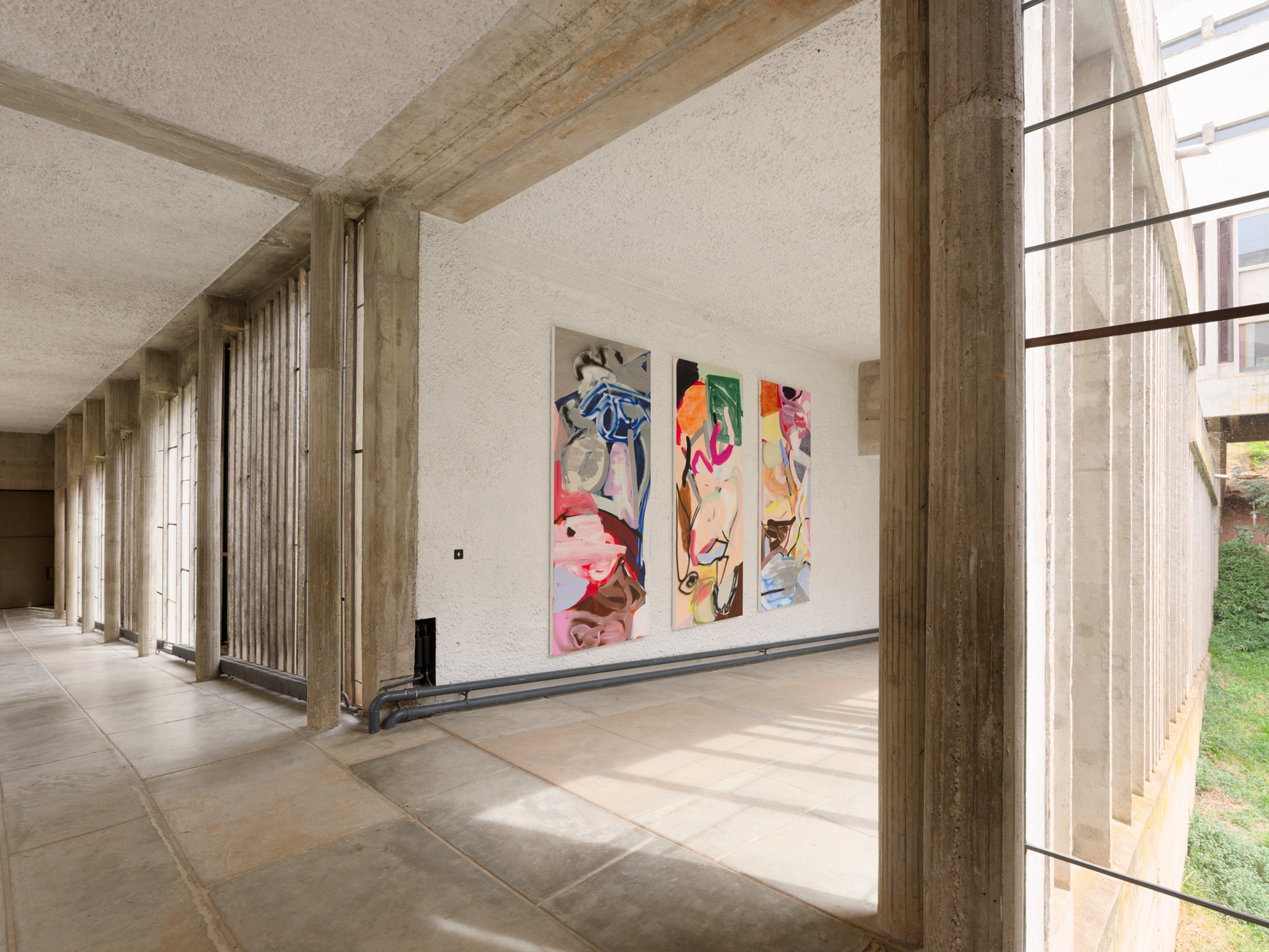
Crédit : Aurélien Mole
Crédit : Aurélien Mole
Liliane TOMASKO
"Les songes de la trame"
Avec « Les songes de la trame », Liliane Tomasko investit le couvent Sainte-Marie de La Tourette, dernière œuvre réalisée par Le Corbusier en France entre 1953 et 1960, comme un espace de dialogue entre architecture, abstraction picturale et intériorité.
L’exposition propose une traversée de l’œuvre de l’artiste, présentant une trentaine de peintures et travaux sur papier réalisés entre 2019 et 2026, au sein d’un lieu où la rigueur moderniste, l’orthogonalité des lignes et l’apparente austérité du béton sont constamment infléchies par une attention minutieuse aux détails. Au fil du parcours, les conduits courant le long des murs et portant les nuances cardinales du modernisme – bleu, jaune, rouge, vert – dessinent des lignes tel une abstraction dans l’espace, des petites niches en béton ornementent un couloir, de longues ouvertures verticales, telles des meurtrières modernes, scandent les espaces intérieurs tandis que des pierres aux lignes organiques nous accueillent à l’entrée. Autant de détails et d’infimes modulations de la matière qui laissent alors affleurer, pour reprendre les mots d’Henri Michaux, comme « une autre vie dans les plis » de l’architecture.
C’est précisément dans ces interstices que se déploie le dialogue avec la peinture de Liliane Tomasko.
À première vue, les toiles de la peintre suisse s’imposent par leur puissance abstraite, elles sont monumentales, chatoyantes, traversées d’élans gestuels, de couleurs d’une rare intensité. Pourtant, cette peinture, loin de se donner uniquement comme expansion ou surface spectaculaire, procède d’un mouvement intérieur. Elle naît d’une attention portée aux fragments ordinaires, aux plis des textiles, aux drapés, aux étoffes froissées, aux détails que seule l’artiste semble voir. Ainsi, dans le contexte du couvent, les peintures de Tomasko invitent à regarder autrement, non plus seulement frontalement, mais dans les coins, les replis et les seuils.
L’exposition se construit comme un parcours placé sous le signe du trois, en écho à la Trinité et à la vocation spirituelle du lieu. Plusieurs ensembles réunissent trois tableaux, ou des multiples de trois, formant des constellations où les œuvres dialoguent entre elles comme autant de variations, d’apparitions ou de visions successives, à la manière de ces instants que l’on croit avoir déjà traversés, sans plus savoir s’ils relèvent du songe ou d’une réminiscence diffuse. Cette structure ternaire ne relève pas seulement d’un principe formel, elle engage une expérience de la peinture comme passage, comme méditation, comme lente traversée du visible vers l’invisible. Chez Liliane Tomasko, le motif n’est jamais donné d’emblée. Il affleure, se dérobe, se transforme. Les plis d’une étoffe, les serviettes de table des Frères qu’elle a photographiées, les fragments domestiques et silencieux deviennent les points de départ d’une abstraction vibrante, où le réel est déplacé.
En cela, le travail de Liliane Tomasko rejoint profondément l’esprit du couvent de La Tourette. Dans ce bâtiment conçu pour la vie communautaire, la prière, l’étude et le retrait, la matière la plus concrète devient support d’élévation. La peinture, comme l’architecture, n’échappe pas au monde, elle en intensifie les qualités enfouies. Comme l’écrit le critique d’art américain Joseph Masheck dans Le Paradigme du tapis, « l’art possède une valeur spirituelle non parce qu’il peut être utilisé pour échapper à la réalité sublunaire, mais parce que, déplaçant seulement un peu de ce monde, il peut intégrer des valeurs humaines de manière si générale. La peinture est un ornement de la vie parce qu’à l’instar des arts décoratifs [tel le textile] elle magnifie au mieux des qualités déjà présentes dans la vie matérielle et le travail. »
« Les songes de la trame » propose ainsi une lecture de l’œuvre de Liliane Tomasko autant qu’une relecture du lieu qui l’accueille. Dans la tension entre rationalisme froid et sensualité du geste pictural, entre monumentalité et détail, entre abstraction et mémoire matérielle, cette exposition rappelle que le spirituel ne se trouve pas hors du monde, mais dans son épaisseur même, dans les plis, les traces, les textures, les gestes répétés, les fragments modestes auxquels l’artiste offre une nouvelle fortune.
Liliane TOMASKO (née en 1967 à Zurich) est une artiste suisse d’origine hongroise. Elle est titulaire d’un Bachelor of Arts en beaux-arts du Chelsea College of Art & Design de Londres, obtenu en 1995, ainsi que d’un Master of Arts en beaux-arts de la Royal Academy of Arts de Londres, obtenu en 1998. Elle vit et travaille à New York.
En 2026, le Ludwig Museum de Coblence, en Allemagne, lui consacre une exposition rétrospective intitulée Bridge.
Parmi ses récentes expositions personnelles institutionnelles figurent The Psyche of the Portrait à la Millennium Gallery de Sheffield (2025) ; Name Me Not au Centro de Arte Contemporáneo Caja de Burgos (CAB), à Burgos, en Espagne (2023) ; The Artist’s Eye à la Douglas Hyde Gallery, à Dublin, en Irlande (2023) ; Evening Wind à l’Edward Hopper House Museum & Study Center, à Nyack (État de New York, États-Unis) (2022) ; Morpheus au Kunstmuseum Kloster Unser Lieben Frauen, à Magdebourg, en Allemagne (2021) ; dark goes lightly au Château La Coste, au Puy-Sainte-Réparade, en France (2019) ; Caja de Sueños au MATE – Museo Mario Testino, à Lima, au Pérou (2018) ; Dusk at Dawn à la Kunsthalle Rostock, en Allemagne (2015) ; Mother–Matrix–Matter au Lowe Art Museum de l’University of Miami, en Floride, États-Unis (2015) ; ainsi que In Visible World au Phoenix Art Museum, à Phoenix, Arizona, États-Unis (2015).
Les œuvres de Liliane Tomasko sont conservées dans de nombreuses collections publiques, parmi lesquelles l’Albertina Museum, Vienne, Autriche ; la Hugh Lane Gallery, Dublin, Irlande ; la Hilti Art Foundation, Schaan, Liechtenstein ; l’IVAM – Institut Valencià d’Art Modern, Valence, Espagne ; le Kunstmuseum Bern, Suisse ; la K20 K21 Kunstsammlung Nordrhein-Westfalen, Düsseldorf, Allemagne ; la Staatliche Kunsthalle Karlsruhe, Allemagne ; la Staatliche Graphische Sammlung München, Allemagne ; la Städtische Galerie im Lenbachhaus, Munich, Allemagne ; le Modern Art Museum of Fort Worth, Fort Worth, Texas, États-Unis ; ainsi que le Lowe Art Museum de l’University of Miami, Floride, États-Unis.
Marjolaine LÉVY est docteure en histoire de l’art contemporain de l’Université Paris-Sorbonne, critique d’art et commissaire d’exposition. Elle est l’autrice de nombreux essais et catalogues d’exposition, parmi lesquels Les Modernologues au MAMCO, Genève, 20 ans d’art en France (Flammarion), ainsi que les premières monographies consacrées aux peintres polonais Józef Hałas et Tomasz Żołnierkiewicz, publiées aux éditions Skira (2023–2026).
Elle a notamment assuré le commissariat des expositions « Le cauchemar de Greenberg » à la Fondation Ricard, Paris (2021) ; « Léon Wuidar, une peinture à géométrie variable » au Bonisson Art Center ; et de la rétrospective « Fausta Squatriti » à la Kunsthaus Pasquart, Bienne (2023).
En 2024, elle a assuré le commissariat de l’exposition « La Société du spectacle » à la Fondation Ricard et a été lauréate du prix BMW Art Makers.
En 2025, elle signe le commissariat de « Super Conceptual Pop » à la Fondation CAB, Bruxelles ; de « Des géométries instables : Léon Wuidar / Brooklin A. Soumahoro » à la galerie Rodolphe Janssen, Bruxelles ; ainsi que de la rétrospective consacrée à Farah Atassi au Musée Picasso de Malaga. En 2026, elle organise la première rétrospective du peintre suédois Olle Baertling à l’Institut suédois, à Paris.
En 2027, elle sera commissaire d’une exposition consacrée à l’abstraction modeste au Musée International des Arts Modestes (MIAM), à Sète, ainsi que de la rétrospective du peintre Joseph Marioni au 447 Space, New York.
Liliane TOMASKO
"Les songes de la trame"
With “Les songes de la trame”, Liliane Tomasko transforms the Couvent Sainte-Marie de La Tourette, Le Corbusier’s final work in France, completed between 1953 and 1960, into a space of dialogue between architecture, abstraction, and inner reflection. The exhibition offers a journey through the artist’s work, bringing together some thirty paintings and works on paper made between 2023 and 2026 within a space where modernist rigour, the orthogonality of lines, and the apparent austerity of concrete are constantly tempered by meticulous attention to detail.
As one moves through the space, the ducting running across the walls in the cardinal hues of modernism—blue, yellow, red, and green—traces lines like an abstraction in space; small concrete niches ornament a corridor; long vertical openings, like modern arrow slits, punctuate the interior spaces; while stones with organic contours greet us at the entrance. All these details and subtle modulations of matter allow, to borrow the words of Henri Michaux, “another life in the folds” of the architecture to emerge.
It is precisely within these interstices that the dialogue with Liliane Tomasko’s painting unfolds. At first glance, the Swiss painter’s canvases command attention with their abstract power; they are monumental and shimmering, traversed by gestural energy and colours of rare intensity. Yet her painting, far from presenting itself as mere expansion or spectacular surface, springs from an inner impulse. It is born of an attention to ordinary fragments, to the folds of textiles, drapery, rumpled fabrics, and details that only the artist seems to see. Thus, in the context of the convent, Liliane Tomasko’s paintings invite us to look differently: no longer just head-on, but into its corners, recesses, and thresholds.
The exhibition is structured as a journey centred on the number three, in an echo of the Trinity and the spiritual vocation of the site. Several ensembles bring together three paintings, or multiples of three, forming constellations in which the works enter into dialogue with one another like so many variations, apparitions, or successive visions, akin to those moments we feel we have already lived, without knowing whether they belong to a dream or a vague memory. This ternary structure is not merely a formal principle; it engages us in an experience of painting as passage, as meditation, as a slow crossing from the visible to the invisible. In Liliane Tomasko’s work, the motif is never given all at once. It emerges, withdraws, transforms. The folds of a fabric, the table napkins of the friars she has photographed, and the silent fragments of domestic life become the starting points for a vibrant abstraction in which reality is displaced.
In this respect, Liliane Tomasko’s work resonates deeply with the spirit of the Couvent de La Tourette. In this building designed for communal life, prayer, study, and retreat, the most concrete material becomes a vehicle for spiritual elevation. Painting, like architecture, does not escape the world; rather, it intensifies its hidden qualities. As the American art critic Joseph Masheck writes in The Carpet Paradigm, “Art has spiritual value, not because it can be used to escape… reality but because in displacing only a little of the world it can implicate the world so generally. Painting is an ornament of life because, as at best in the ‘applied’ or decorative arts themselves, it magnifies qualities already present in the material life and world.”
“Les songes de la trame” thus offers both an interpretation of Liliane Tomasko’s work and a reinterpretation of the space that hosts it. In the tension between cold rationalism and the sensuality of the pictorial gesture, between monumentality and detail, between abstraction and material memory, this exhibition reminds us that the spiritual is not found outside the world, but within its very depth—in the folds, the traces, the textures, the repeated gestures, and the modest fragments to which the artist offers a new life.
Liliane TOMASKO (b. 1967, Zurich) is a Swiss artist of Hungarian descent. She received a BA in Fine Art from Chelsea College of Art & Design, London, in 1995, and an MA in Fine Art from the Royal Academy of Arts, London, in 1998. She currently lives and works in New York.
In 2026, Tomasko is the subject of the retrospective exhibition Bridge at the Ludwig Museum, Koblenz, Germany. Other recent institutional solo exhibitions include The Psyche of the Portrait at the Millennium Gallery, Sheffield, UK (2025); Name Me Not at the Centro de Arte Contemporáneo Caja de Burgos (CAB), Burgos, Spain (2023); The Artist’s Eye at The Douglas Hyde Gallery, Dublin, Ireland (2023); Evening Wind at the Edward Hopper House Museum & Study Center, Nyack, New York, USA (2022); Morpheus at the Kunstmuseum Kloster Unser Lieben Frauen, Magdeburg, Germany (2021); dark goes lightly at Château La Coste, Le Puy-Sainte-Réparade, France (2019); Caja de Sueños at MATE – Museo Mario Testino, Lima, Peru (2018); Dusk at Dawn at Kunsthalle Rostock, Germany (2015); Mother–Matrix–Matter at the Lowe Art Museum, University of Miami, Florida, USA (2015); and In Visible World at the Phoenix Art Museum, Phoenix, Arizona, USA (2015).
Tomasko’s work is held in numerous public collections, including the Albertina Museum, Vienna, Austria; Hugh Lane Gallery, Dublin, Ireland; Hilti Art Foundation, Schaan, Liechtenstein; IVAM – Institut Valencià d’Art Modern, Valencia, Spain; Kunstmuseum Bern, Switzerland; K20 K21 Kunstsammlung Nordrhein-Westfalen, Düsseldorf, Germany; Staatliche Kunsthalle Karlsruhe, Germany; Staatliche Graphische Sammlung München, Germany; Städtische Galerie im Lenbachhaus, Munich, Germany; The Modern Art Museum of Fort Worth, Fort Worth, Texas, USA; and the Lowe Art Museum, University of Miami, Florida, USA.
Marjolaine LÉVY holds a Ph.D. in Contemporary Art History from Paris-Sorbonne University and is an art critic and curator. She is the author of numerous essays and exhibition catalogues, including Les Modernologues at MAMCO, Geneva, 20 Years of Art in France (Flammarion), as well as the first monographs dedicated to the Polish painters Józef Hałas and Tomasz Żołnierkiewicz, published by Skira (2023–2026).
She notably curated the exhibitions Greenberg’s Nightmare at the Fondation Ricard, Paris (2021); Léon Wuidar: A Painting of Variable Geometry at the Bonisson Art Center; and the retrospective Fausta Squatriti at the Kunsthaus Pasquart, Biel (2023). In 2024, she curated The Society of the Spectacle at the Fondation Ricard and was awarded the BMW Art Makers Prize.
In 2025, she curated Super Conceptual Pop at the CAB Foundation, Brussels; Unstable Geometries: Léon Wuidar / Brooklin A. Soumahoro at the Rodolphe Janssen Gallery, Brussels; and the retrospective dedicated to Farah Atassi at the Picasso Museum in Málaga. In 2026, she organized the first retrospective of the Swedish painter Olle Baertling at the Swedish Institute in Paris. In 2027, she will curate an exhibition dedicated to Modest Abstraction at the Musée International des Arts Modestes (MIAM), Sète, as well as a retrospective of the painter Joseph Marioni at 447 Space, New York.